




Leash Reactivity vs Aggression: Know Your Dog's Behavior
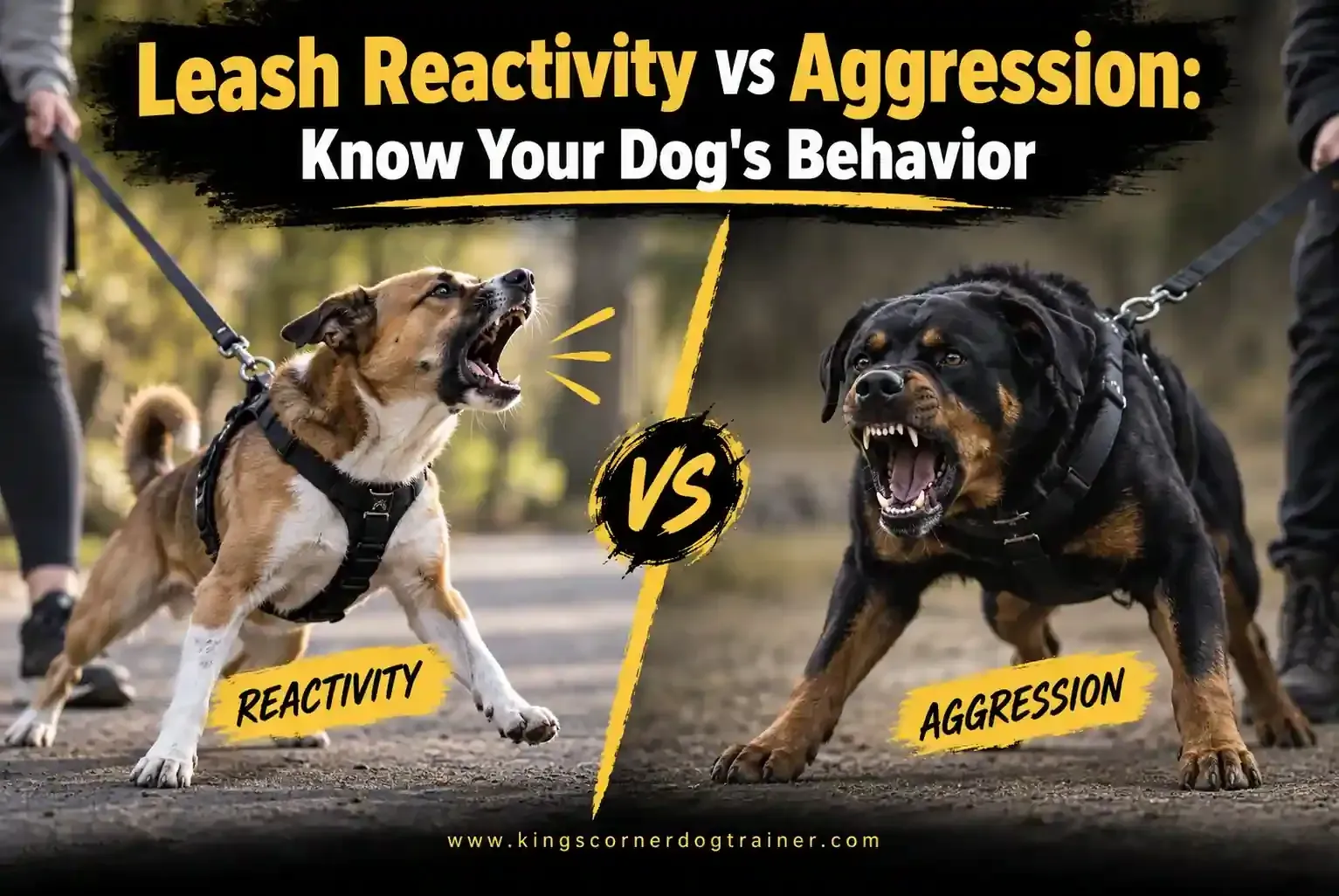
Your dog sees another dog across the street. Suddenly, the leash tightens. Your dog starts barking, pulling, growling, or lunging. To anyone watching, the behavior may look aggressive.
But is your dog actually aggressive?
Understanding leash reactivity vs aggression is important because similar behaviors can come from very different emotions. A dog may bark and lunge because they are frightened, frustrated, overly excited, or genuinely trying to create distance from another dog or person.
Correctly identifying what is driving the behavior helps you choose a safer and more effective training approach.
What Is Leash Reactivity?
A leash reactive dog has an unusually intense response to certain triggers while on a leash. Common triggers include other dogs, strangers, bicycles, cars, children, skateboards, or unfamiliar situations.
A reactive dog may:
- Bark repeatedly
- Lunge toward a trigger
- Pull hard on the leash
- Whine or growl
- Stare intensely
- Spin or jump
- Become difficult to redirect
- Ignore commands they normally understand
These signs of leash reactivity do not automatically mean a dog intends to attack.
Some dogs react because they desperately want to greet another dog but the leash prevents them. Others react because they are afraid and want the trigger to move farther away. Reactivity can therefore be driven by excitement, frustration, anxiety, or fear.
The American Kennel Club describes reactivity as an excessive emotional response to an ordinary situation and notes that fear, frustration, and excitement can all contribute to the behavior.
What Is Dog Aggression?
Dog aggression involves behaviors associated with threatening, creating distance from, intimidating, or potentially harming another person or animal.
Aggressive behavior can include:
- Growling
- Snarling
- Showing teeth
- Stiff body posture
- Snapping
- Lunging
- Biting
However, context matters.
A growl does not always mean a dog is about to bite, and barking on a leash does not automatically make a dog aggressive.
Aggression can develop for several reasons, including fear, guarding resources, territorial behavior, pain, frustration, or previous negative experiences. Sudden behavioral changes may also warrant a veterinary evaluation because discomfort or health problems can sometimes contribute to aggression.
Leash Reactivity vs. Aggression: What Is the Difference?
The simplest way to understand leash reactivity vs aggression is to look beyond what the behavior looks like and consider what may be motivating it.
A reactive dog is experiencing a high level of emotional arousal in response to a trigger.
An aggressive dog is displaying behavior intended to threaten, repel, control, or potentially harm the target.
This distinction is not always easy for owners to identify because the outward behaviors can look almost identical.
For example, two dogs may both bark and lunge toward another dog.
One might be thinking, "I want to go meet that dog!"
The other may be communicating, "Stay away from me."
That is why evaluating a reactive dog vs aggressive dog requires looking at the dog's history, body language, triggers, distance from the trigger, and behavior in different environments.
Why Does My Dog Bark and Lunge on a Leash?
Dog barking and lunging on leash can happen for several reasons.
Frustration
Some dogs love other dogs or people but become frustrated because the leash prevents them from approaching.
These dogs are sometimes described as frustrated greeters. They may appear intimidating even though their primary motivation is excitement rather than aggression.
Fear
Fear is another common cause of reactive dog behavior.
A frightened dog may bark or lunge because the behavior has successfully caused people or dogs to move away in the past.
If barking makes the scary thing disappear, the dog may learn to repeat the behavior.
Lack of Socialization
Dogs that did not receive appropriate exposure to different environments, people, animals, sounds, and experiences may become overwhelmed more easily.
An unfamiliar situation that seems ordinary to you can feel highly threatening or exciting to your dog.
Previous Negative Experiences
A frightening encounter with another dog or person can influence future reactions.
For example, a dog that was attacked during a walk may become nervous whenever another dog approaches.
Restraint From the Leash
The leash limits a dog's ability to choose whether to move toward or away from something.
That restriction can increase frustration or anxiety in some dogs. This is one reason a dog may behave calmly around other dogs in certain situations but become highly reactive when restrained.
Can Leash Reactivity Turn Into Aggression?
Yes, dog reactivity can sometimes escalate into aggressive behavior.
A highly aroused dog may have difficulty responding to commands or making calmer choices. Repeated exposure to triggers at a level the dog cannot handle can also reinforce unwanted reactions.
A fearful dog may initially bark to create distance. If barking does not work and another dog continues approaching, the behavior could escalate to growling, snapping, or biting.
This does not mean every reactive dog will become aggressive. It does mean owners should take repeated reactivity seriously rather than assuming the dog will eventually grow out of it.
What Is Leash Aggression?
Leash aggression refers to aggressive behavior that occurs while a dog is restrained on a leash.
The term is sometimes used interchangeably with leash reactivity, but they are not necessarily the same.
A dog may be leash reactive because of excitement or frustration without demonstrating aggression. Alternatively, a dog may genuinely use aggressive behavior while leashed to make another dog or person move away.
Because motivation can be difficult to determine from appearance alone, avoid deliberately allowing your dog to approach another animal simply to "see what happens." Removing distance as a safety measure can create unnecessary risk. Veterinary behavior guidance specifically cautions against removing barriers to test the intentions of a lunging dog.
How to Help a Reactive Dog
Learning how to help a reactive dog starts with preventing repeated situations where the dog becomes overwhelmed.
1. Identify Your Dog's Triggers
Keep track of exactly what causes reactions.
Is it every dog, only large dogs, men wearing hats, bicycles, runners, or people approaching directly?
The more specific you can be, the easier it becomes to develop an effective training plan.
2. Create More Distance
Distance is one of the most useful tools in reactive dog training.
If your dog starts barking when another dog is 10 feet away but remains calm at 40 feet, begin training at the greater distance.
Your dog should ideally notice the trigger while still being able to respond to you.
3. Redirect Attention Early
Do not wait until your dog is already barking and lunging.
When you notice a trigger approaching, ask for a familiar behavior such as:
- Look at me
- Heel
- Sit
- Touch
- Let's go
Reward your dog for successfully shifting attention back toward you.
Basic obedience skills can become valuable tools when managing reactions in everyday environments.
4. Build Positive Associations
One commonly used form of dog behavior modification involves gradually exposing a dog to a trigger at a manageable distance while pairing the experience with something positive.
The goal is not to force the dog closer.
The goal is to help the dog remain calm enough to learn.
Current veterinary behavior guidance favors reward-based training and management strategies for behavior problems rather than punishment-based methods.
5. Avoid Punishing the Reaction
Yelling, harsh leash corrections, or punishing growling may increase fear, frustration, and arousal.
Punishment may also suppress warning signals without addressing the underlying emotion responsible for the behavior.
Instead, focus on preventing reactions, rewarding calmer choices, and gradually changing the dog's response to triggers.
When Should You Get Professional Help?
You should consider working with a dog trainer for reactive dogs when:
- Your dog is difficult to physically control
- Reactions are becoming more intense
- Your dog has snapped or bitten
- Your dog redirects aggression toward you
- Walks have become stressful or unsafe
- You cannot identify the trigger
- Your current training approach is not improving the behavior
Dogs with serious aggression or sudden major behavioral changes may also need evaluation by a veterinarian or veterinary behavior professional.
Kings Corner Dog Trainer LLC offers behavior modification, in-home dog training, obedience training, and programs addressing reactivity and aggression in the Las Vegas area. The company's behavioral modification service focuses on identifying triggers and creating individualized approaches for unwanted behaviors.
Helping Your Dog Build Better Behavior
Understanding leash reactivity vs aggression can change the way you approach your dog's behavior.
Barking, pulling, and lunging may look frightening, but those behaviors alone do not reveal exactly what your dog is feeling. Fear, frustration, excitement, anxiety, and genuine aggression can produce similar reactions.
Instead of focusing only on stopping the barking or pulling, look at what causes the behavior.
Identify triggers, create appropriate distance, teach reliable obedience skills, reward calmer responses, and seek professional help when necessary.
With structured reactive dog training, consistent practice, and the right management strategy, many dogs can learn more appropriate ways to respond when they encounter triggers.
Frequently Asked Questions
Is a leash reactive dog aggressive?
Not necessarily. A leash reactive dog may bark, growl, or lunge because of excitement, frustration, fear, or anxiety. Some reactive dogs may also display aggression, so the dog's motivation and history should be evaluated carefully.
Why is my dog aggressive on leash but friendly off leash?
The leash can prevent a dog from approaching, retreating, or interacting naturally. This restriction may increase frustration or fear. Some dogs therefore show stronger reactions while restrained even if they behave differently in other controlled situations.
How do I know if my dog is reactive or aggressive?
Look at the dog's triggers, history, body language, behavior at different distances, and behavior outside the leash context. Because reactive dog vs aggressive dog behavior can look very similar, a qualified professional can help evaluate difficult or potentially dangerous cases.
Can leash reactivity be fixed?
Many dogs can make meaningful progress through trigger management, appropriate distance, structured training, and behavior modification. The timeline varies based on the dog's history, temperament, triggers, training consistency, and severity of the behavior.
Should I let my reactive dog meet other dogs?
Do not force greetings as a way to test your dog. If your dog is already highly aroused, allowing another dog to approach can make the situation more difficult or unsafe. Controlled exposure should occur at a distance where your dog can remain manageable.
When should I seek dog aggression training in Las Vegas?
Consider dog aggression training Las Vegas support if your dog repeatedly growls, snaps, lunges, attempts to bite, has a bite history, or creates safety concerns around people or animals. Professional assessment can help determine an appropriate management and training strategy.